Lithium-ion batteries (LIBs) power electric vehicles, electric aircraft, and grid-scale storage, all of which can experience crash, drop, or puncture events in service. Mechanical abuse is one of the least understood triggers of thermal runaway: a cell can suffer internal damage in an impact, show no external sign, and fail catastrophically later. Understanding how LIBs fail under dynamic loading, and detecting that damage the moment it occurs, is therefore a prerequisite for the safe deployment of electrified transport and storage.
This research program addresses battery impact safety as an independent stream with its own experimental and computational methodology, organized around three questions. How do cells fail under impact? Systematic drop-weight and high-velocity impact campaigns characterize failure modes and identify the impact-energy thresholds that separate safe deformation from internal short circuit. Can damage be detected in real time, without opening the cell? Deep learning models on acoustic emission signals classify damage states as they happen, reaching 98.3% accuracy with a CNN-BiLSTM architecture. How does cell-level damage propagate to system level? Multiphysics finite element models couple mechanical deformation with electrochemical response, linking local damage to pack-level instability across states of charge.
The stream is expanding rather than winding down. Four papers appeared in 2026, and further work is in preparation on cell-level damage mechanisms and on the response of complete packs, carried out both at KAIST and with collaborating groups.
Key Contributions
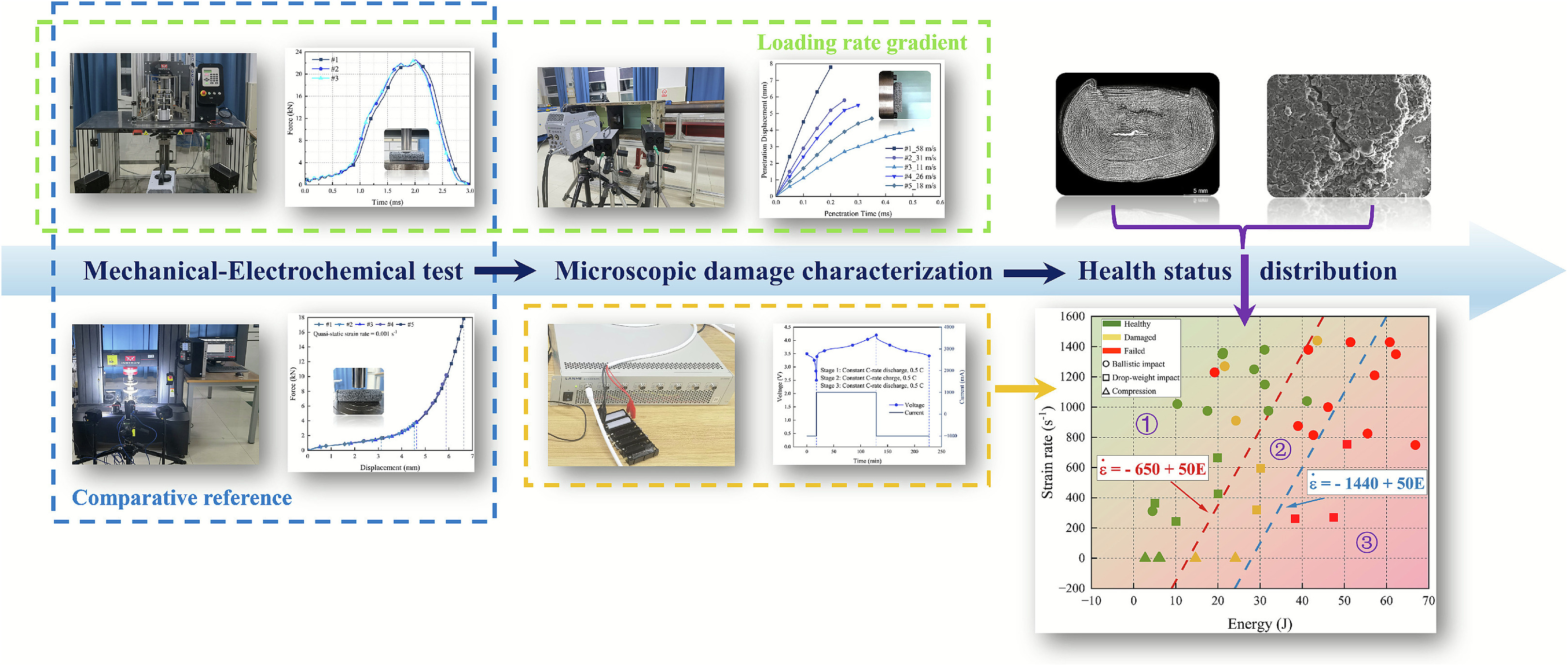
- Systematic experimental investigation coupling loading rate and energy input to LIB internal failure mechanisms
- Failure mode map established: ductile deformation at low strain rates vs. shear-driven fracture at high strain rates
- Critical energy thresholds for LIB failure determined across quasi-static, drop-weight, and high-velocity impact loading regimes
- Counter-intuitive finding: higher strain rate hardens the material, reducing damage in certain impact energy ranges
- Electrochemical diagnostics (impedance spectroscopy, capacity tests) integrated with mechanical characterization
- Three design principles proposed: strain-rate adaptive materials, expanded elastic deformation range, fail-safe mechanisms
Key Contributions
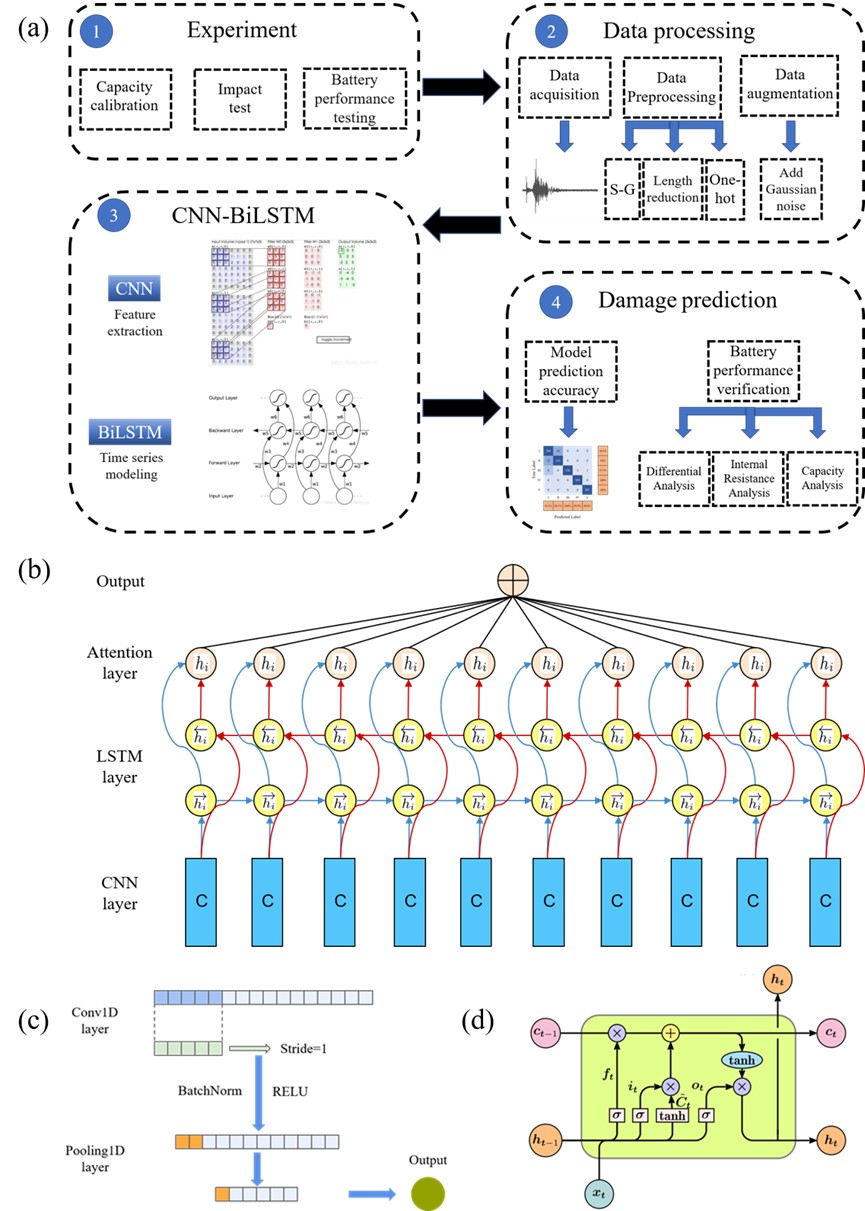
- CNN-BiLSTM deep learning framework for real-time, non-invasive detection of LIB impact damage
- Acoustic emission (AE) signals used as the sensing modality — no modification to battery cell required
- Four-level internal damage classification achieved with 98.3% accuracy
- Savitzky-Golay smoothing and Gaussian noise augmentation implemented for robust model training
- AE signal features physically correlated with electrochemical degradation modes confirmed by post-test analysis
- Framework provides early safety warning capability directly applicable to battery management systems (BMS)
Key Contributions
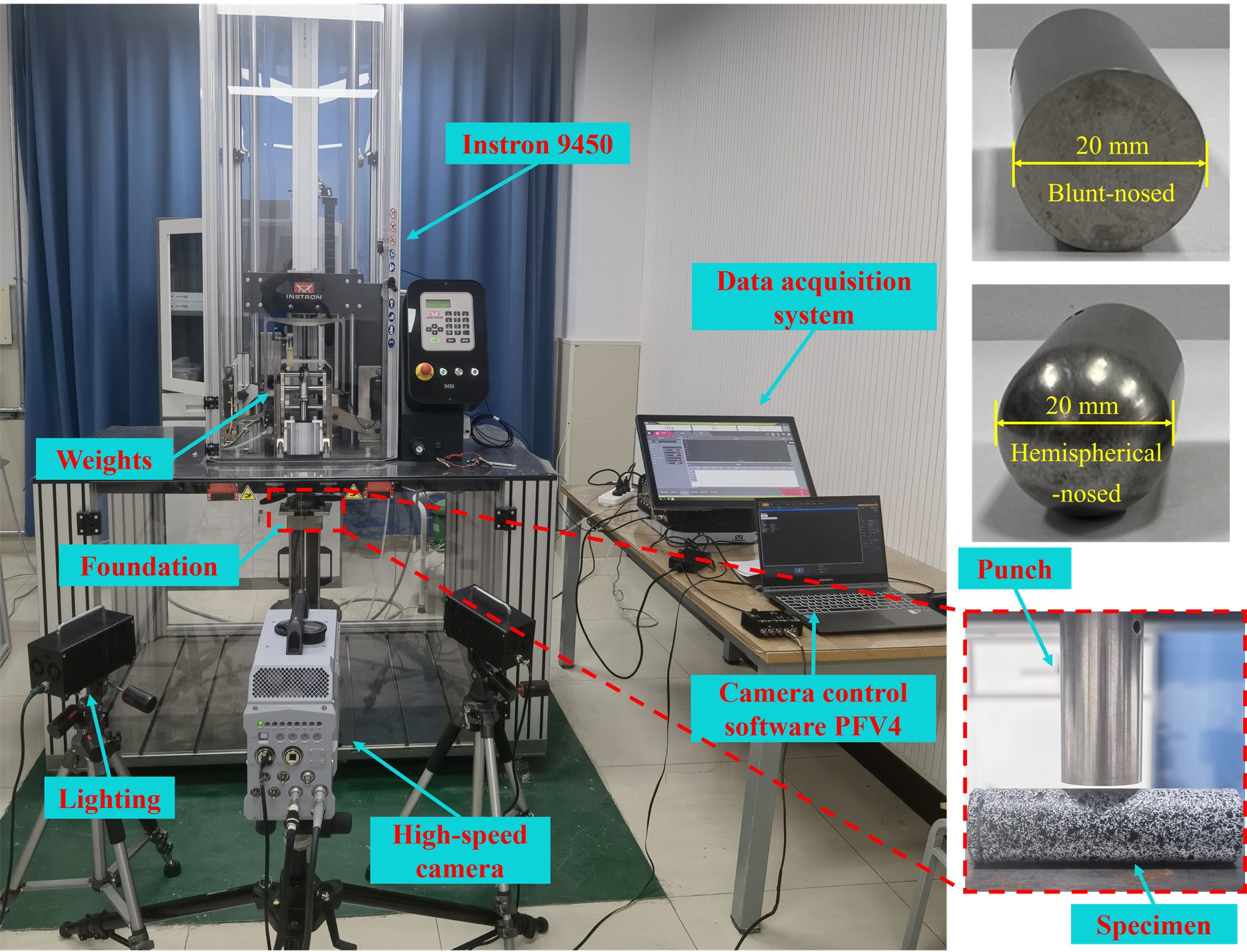
- Multidimensional performance stability assessment methodology for LIB systems under impact loading
- Effects of state-of-charge (SOC) and battery-pack configuration on impact response systematically investigated
- FEM models developed considering anisotropic material properties and SOC-dependent mechanical behavior
- Key finding: high SOC improves stiffness and impact resistance but reduces post-impact electrochemical reversibility
- Low-SOC batteries exhibit better energy absorption capacity but show worse post-impact degradation
- Battery-pack configuration effectively mitigates SOC effects through load redistribution and stress redistribution
Key Contributions
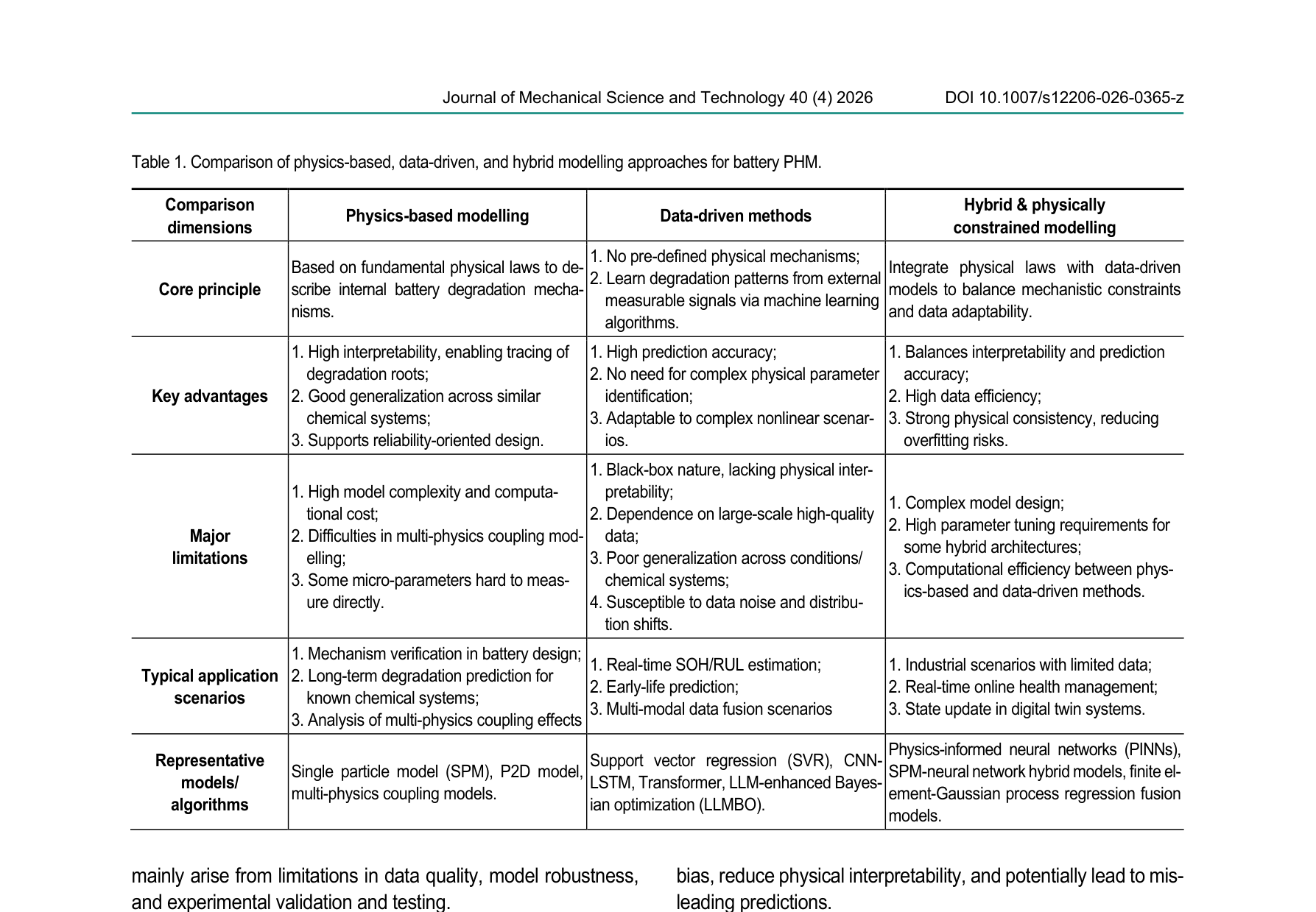
- Comprehensive systematic review of the battery PHM field over the past decade
- Identifies the "homogenization bottleneck" — current methods overfit to specific battery chemistries and neglect mechanistic understanding
- Three paradigms reviewed: physics-based modeling, data-driven approaches, and hybrid methods
- Proposes a research framework balancing data-driven efficiency with physics-based interpretability
- Addresses multi-scale, multi-physics health modeling from electrode-level to pack-level
- Future directions outlined: digital twins, explainable AI, edge computing integration, and industrial standardization
"Current battery safety standards are built around quasi-static tests, yet real accidents are dynamic. The significance of this stream lies in closing that gap: quantified impact-energy thresholds that can inform test standards, a monitoring approach that detects internal damage without disassembling the cell, and simulation tools that trace how an impact on one cell destabilizes a pack. Future work will deepen the mechanical-electrochemical coupling and extend the experiments toward module- and pack-level dynamic abuse."— Research significance and outlook: from cell-level failure physics toward impact safety standards for energy storage