Lithium-ion batteries (LIBs) are increasingly deployed in safety-critical applications — electric vehicles, aerospace, and portable electronics — where they may be subjected to mechanical abuse including impact, crush, and penetration. Understanding how LIBs fail under dynamic loading, and developing systems to detect damage in real time, is essential for safe deployment.
This research program leverages Dr. Huang's background in impact mechanics and constitutive modeling to address battery safety from a fundamentally mechanical perspective. The work spans experimental characterization of failure modes, acoustic emission-based real-time monitoring with deep learning, multiphysics finite element modeling, and systematic review of the broader PHM field. The long-term vision is to apply constitutive modeling methods directly to battery electrode and separator materials — building a rigorous mechanical-electrochemical framework for safety under dynamic loading.
Key Contributions
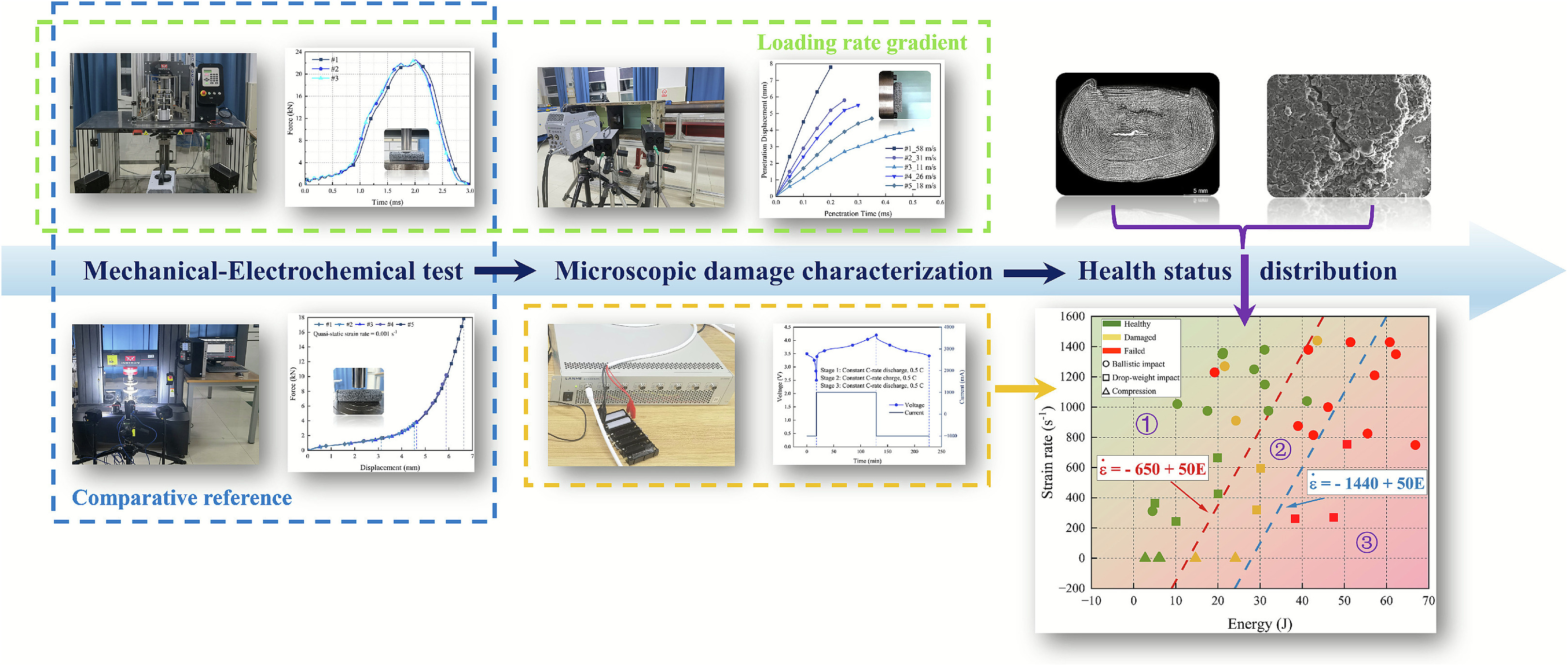
- Systematic experimental investigation coupling loading rate and energy input to LIB internal failure mechanisms
- Failure mode map established: ductile deformation at low strain rates vs. shear-driven fracture at high strain rates
- Critical energy thresholds for LIB failure determined across quasi-static, drop-weight, and ballistic loading regimes
- Counter-intuitive finding: higher strain rate hardens the material, reducing damage in certain impact energy ranges
- Electrochemical diagnostics (impedance spectroscopy, capacity tests) integrated with mechanical characterization
- Three design principles proposed: strain-rate adaptive materials, expanded elastic deformation range, fail-safe mechanisms
Key Contributions
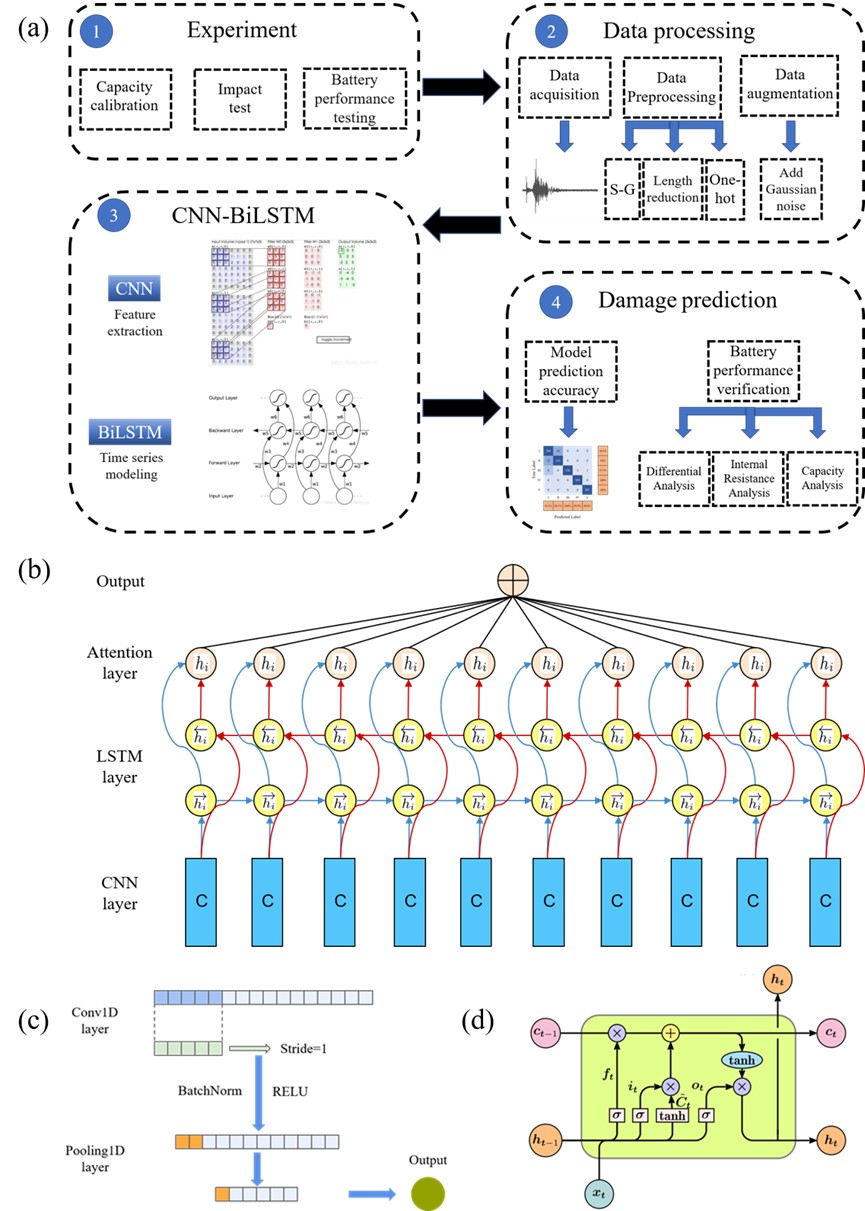
- CNN-BiLSTM deep learning framework for real-time, non-invasive detection of LIB impact damage
- Acoustic emission (AE) signals used as the sensing modality — no modification to battery cell required
- Four-level internal damage classification achieved with 98.3% accuracy
- Savitzky-Golay smoothing and Gaussian noise augmentation implemented for robust model training
- AE signal features physically correlated with electrochemical degradation modes confirmed by post-test analysis
- Framework provides early safety warning capability directly applicable to battery management systems (BMS)
Key Contributions
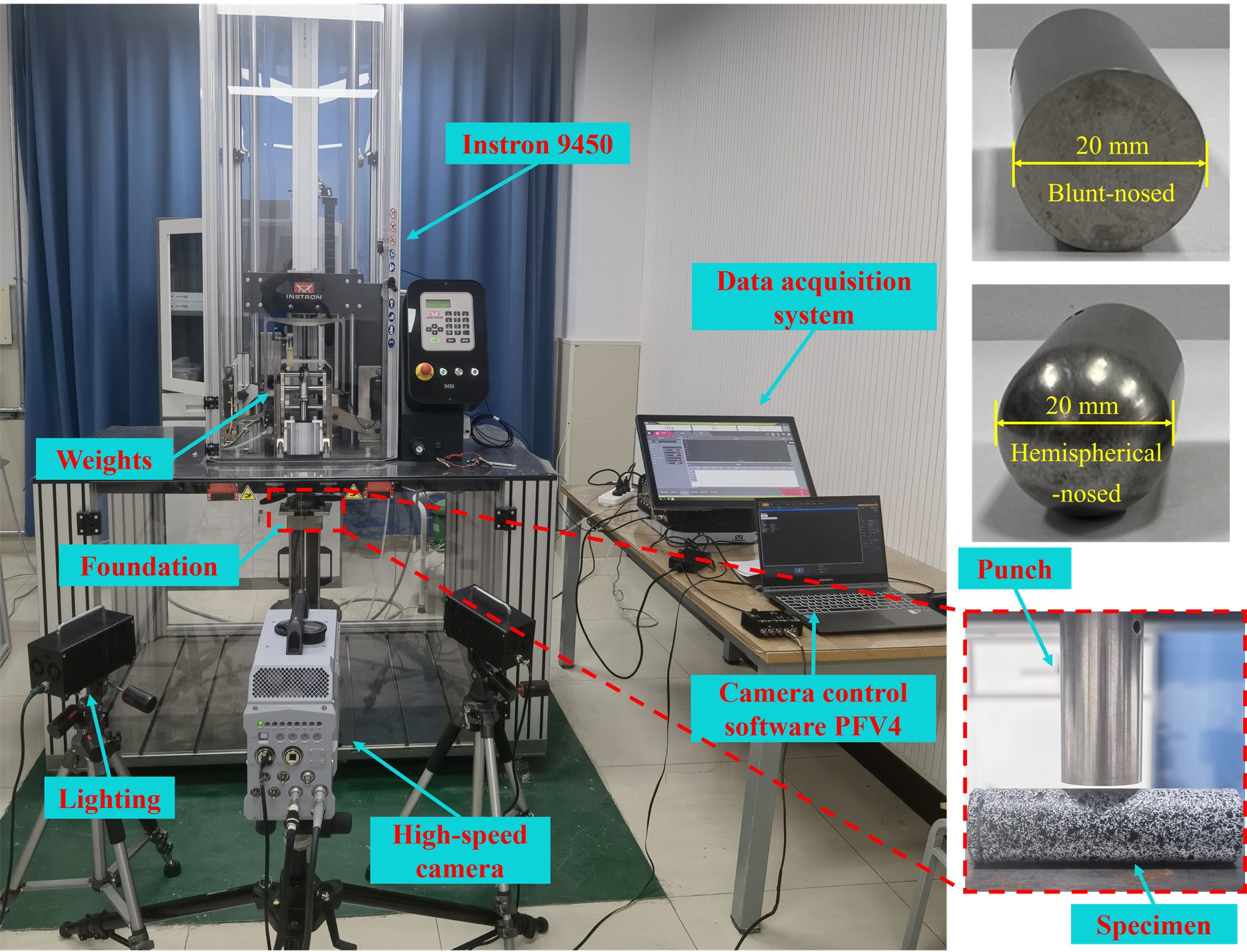
- Multidimensional performance stability assessment methodology for LIB systems under impact loading
- Effects of state-of-charge (SOC) and battery-pack configuration on impact response systematically investigated
- FEM models developed considering anisotropic material properties and SOC-dependent mechanical behavior
- Key finding: high SOC improves stiffness and impact resistance but reduces post-impact electrochemical reversibility
- Low-SOC batteries exhibit better energy absorption capacity but show worse post-impact degradation
- Battery-pack configuration effectively mitigates SOC effects through load redistribution and stress redistribution
Key Contributions
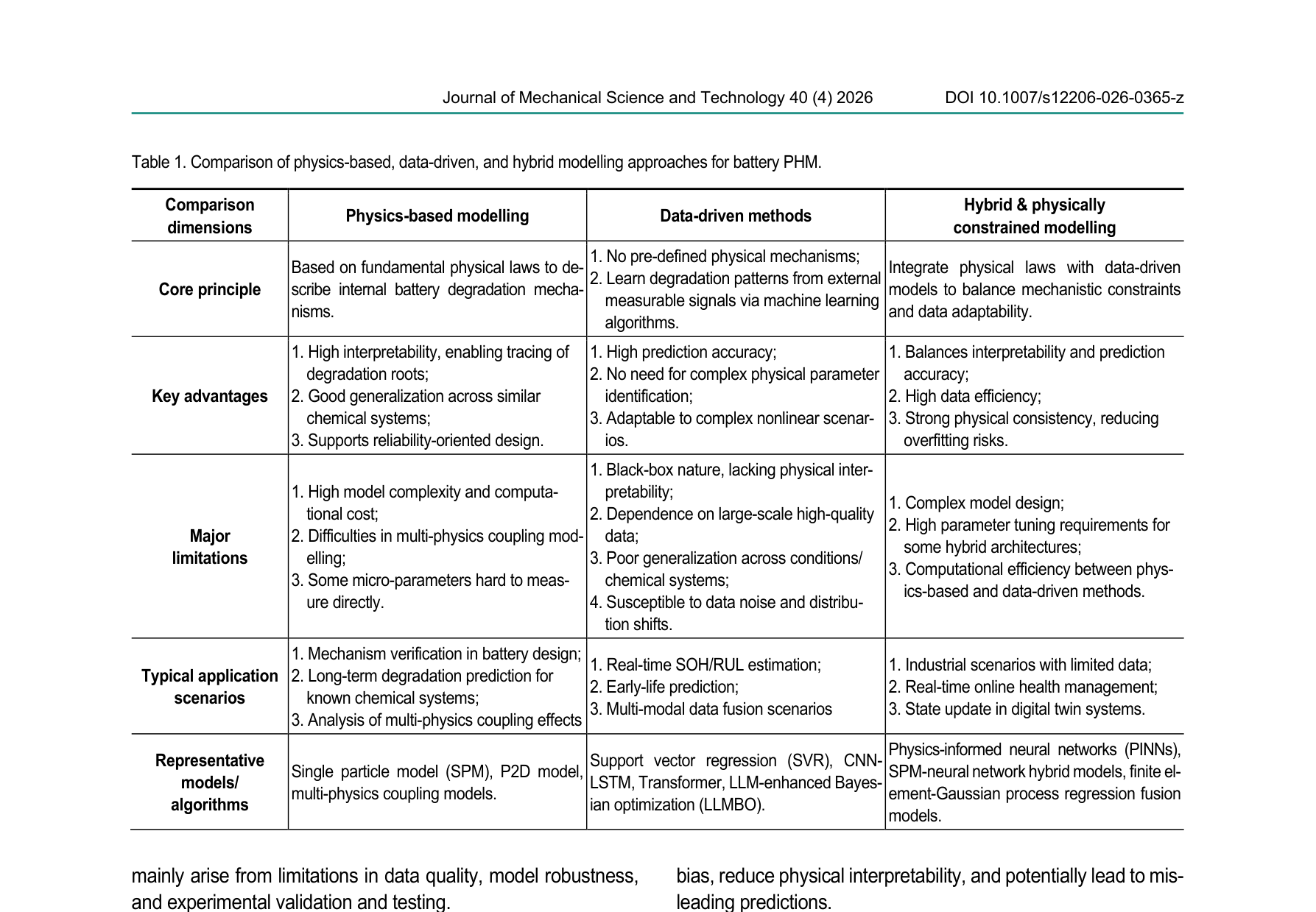
- Comprehensive systematic review of the battery PHM field over the past decade
- Identifies the "homogenization bottleneck" — current methods overfit to specific battery chemistries and neglect mechanistic understanding
- Three paradigms reviewed: physics-based modeling, data-driven approaches, and hybrid methods
- Proposes a research framework balancing data-driven efficiency with physics-based interpretability
- Addresses multi-scale, multi-physics health modeling from electrode-level to pack-level
- Future directions outlined: digital twins, explainable AI, edge computing integration, and industrial standardization
"The long-term academic vision is to establish impact dynamics — particularly constitutive modeling under high strain-rate loading — as the primary research identity. Battery impact safety serves as an important and strategically chosen application domain, where the physics of dynamic loading and structural failure are directly relevant. Future directions in this battery research thread will focus on deepening the mechanical-electrochemical coupling and developing more rigorous predictive frameworks for battery safety under dynamic abuse."— Long-term research vision: impact dynamics as core identity, battery safety as application domain